
Malaysia Medical Device Registration & Regulatory Services
MediPass helps you navigate MDA requirements with clarity — from Product Classification, Grouping, and Conformity Assessment Body (CAB) Selection to Local Regulatory Coordination and Post-Market Compliance.
Class A–D, Single, Family,
System, Set, IVD Test Kit, IVD Cluster
Conformity Assessment Body (CAB) Selection & CSDT Dossier Preparation
Authorized Representative &
Compliance
Vigilance, Adverse Event Reporting,
FSCA & Recall
Malaysia & Southeast Asia
Strategy
One Regional Partner
for Foreign Manufacturers
The ASEAN Medical Device Directive (AMDD) supports regulatory harmonisation across Southeast Asia, but it does not create a single approval valid across all ASEAN markets. In practice, each country still maintains its own regulatory authority, local requirements, and registration pathway.
For foreign manufacturers, MediPass supports Malaysia market entry while serving as the One Regional Partner for broader ASEAN planning. We help align country-specific registration strategy, local representation, and post-market coordination across multiple ASEAN markets.
Malaysia Market Snapshot
Key demographic, economic, and medical device registration indicators relevant to Malaysia market entry.
Country Overview
Selected macro indicators based on 2025 data
Medical Device
Selected MDA indicators (last update on 22nd March 2026)
Medical Devices in Malaysia
Regulated by the Medical Device Authority (MDA) under the Medical Device Act 2012 (Act 737) and Medical Device Regulations 2012. Market entry typically involves device classification, grouping assessment, submission planning, and registration through MeDC@St.
Registration Process
Determine
Device Status
Classify
A / B / C / D
Define
Grouping
Prepare
CSDT Dossier
Submit
CAB & MeDC@St
Registration Pathways
In Malaysia, Class A medical devices shall be submitted directly via MeDC@St, whereas Class B, C, and D devices require Conformity Assessment Body (CAB) conformity assessment first, with expedited routes available for devices that have obtained approval in any of the recognized reference markets.
Class A medical devices in Malaysia are low-risk products that shall be registered with the Medical Device Authority (MDA) directly through the MeDC@St system (MeDC@St is a web-based online application system under the MDA).
Verification Route
The simplified Verification Route is applicable to devices that have obtained at least one (1) approval from a recognized reference agency, namely Australia TGA, Health Canada, a European Union Notified Body, Japan MHLW, the United States FDA, Singapore HSA, or Thailand FDA. The device is first assessed by an accredited Conformity Assessment Body (CAB), after which the MDA then makes the final approval decision.
Full Conformity Assessment (FCA)
A Full Conformity Assessment (FCA) is required for devices that have not obtained prior approval from a recognized reference agency. The device is first assessed by an accredited Conformity Assessment Body (CAB), after which the MDA then makes the final approval decision.
Classification at a Glance
In Malaysia, both General Medical Devices and In Vitro Diagnostics (IVD) are classified into four risk-based classes, from Class A to Class D. The higher the risk class, the greater the level of regulatory control required for market access.
General Medical Devices
Devices intended for use in or on the human body for medical purposes, whose primary action is not achieved by pharmacological, immunological, or metabolic means.
Tongue depressor, Examination gloves or lights, Adhesive bandages (plasters), Walking aids…
Fixed dental prosthesis, Anesthetic breathing circuits, Endoscopy System, Sleep therapy, Hearing aids…
Ureteral Stent, Lung ventilator, Orthopedic implants, Contact lens disinfecting/cleaning, Defibrillator…
Bone Grafts, Blood bags, Sodium hyaluronate syringes, Central venous or Neurological catheters…
In Vitro Diagnostics (IVD)
Devices intended for the in vitro examination of specimens derived from the human body to provide medical or diagnostic information.
Culture media, Specimen receptacles (urine cups), Microscope, Freezer, Centrifuge, Collection Swab…
Pregnancy, Fertility, RNA extraction, Ovulation, Blood tube, Drugs of abuse, Hepatitis A, H.Pylori Tests …
Blood glucose, PSA, Syphilis, Human papillomavirus (HPV), Dengue, Respiratory viruses Tests (Influenza)…
HIV blood donor screening/diagnostic tests, ABO blood typing, Hepatitis B, Hepatitis C Tests…
Grouping Strategy for Efficient Registration Planning
In Malaysia, Grouping is not only a filing format. An early grouping strategy helps reduce duplicate registrations and simplify lifecycle management.
· One proprietary name · One manufacturer · One common intended purpose
Single
A single medical device supplied as a distinct packaged entity under one proprietary name for one specific intended purpose. It may be offered in different pack sizes, provided it does not meet the criteria for another grouping route.
Family
A group of medical devices from the same manufacturer and of the same risk classification, sharing the same proprietary name, intended purpose, design, and manufacturing process, with differences limited to permissible variants only.
System
A group of compatible medical devices, accessories, or constituent components intended to be used together for one common intended purpose, and marketed under a system name or clearly identified in the labelling / IFU as intended for use with that system.
Set
A collection of two or more medical devices assembled together as one package by a manufacturer under a single set name for a common intended use. The set is classified according to the highest classified device within the set.
IVD Test Kit
A grouping of compatible reagents and/or articles intended to be used together for one specific test or assay under a single test kit name. Instruments such as analysers are not included.
IVD Cluster
A specific IVD grouping route for Class A or Class B reagents or articles that share the same methodology, cluster category, and test principle under the MDA closed-list cluster framework.
Get Your Free Malaysia Market Assessment
Submit your product details and let MediPass recommend the most efficient filing strategy — saving you time, reducing costs, and providing actionable guidance for smooth market entry in Malaysia, and across Southeast Asia.
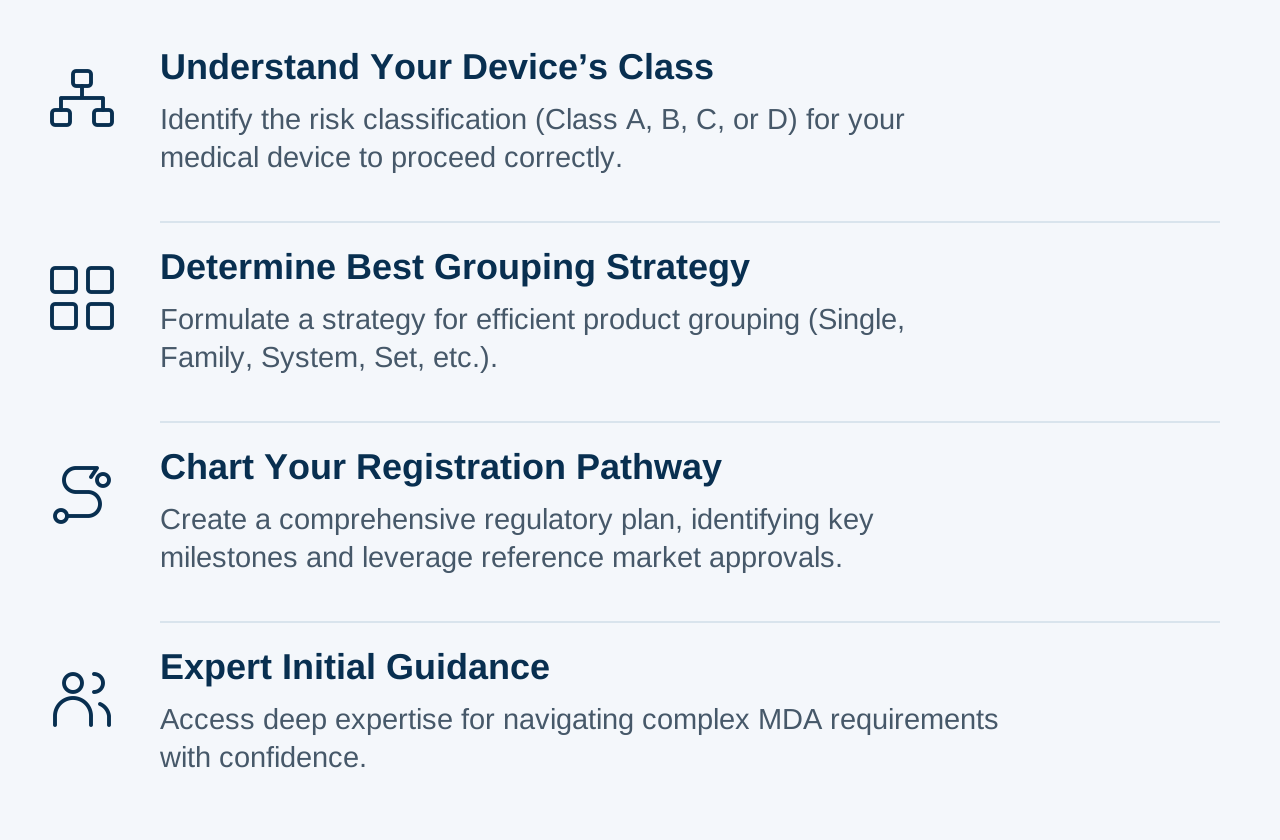
Identify the risk classification (Class A, B, C, or D) for your medical device to proceed correctly.
Formulate a strategy for efficient product grouping (Single, Family, System, Set, etc.).
Create a comprehensive regulatory plan, identifying key milestones and leverage reference market approvals.
Access deep expertise for navigating complex MDA requirements with confidence.
Need help with classification, grouping strategy, or registration pathway?
*Accepted file types include IFUs, Brochures, or existing Approval documents. Please attach to help us assess your product.
Initial assessment within 1 business day
Malaysia CAB and MDA Fee Overview (Effective January 1, 2026) |
|||
|---|---|---|---|
| Device Classification | Conformity Assessment Body Fee | MDA Fees | |
| Application Fee | Processing Fee | ||
| Class A | N/A | RM 500 | RM 750 |
| Class B | Fees for Classes B, C, D and combination devices vary depending on the registration route chosen—Evaluation Route or Full Conformity Assessment (FCA)—and the Conformity Assessment Body (CAB) selected. MediPass provides indicative amounts through our Free Assessment; however, final fees are determined by the CAB’s official quotation. | RM 250 | RM 1,000 |
| Class C | RM 500 | RM 2,000 | |
| Class D | RM 750 | RM 3,000 | |
| Device that contains a medicinal product | RM 750 | RM 5,000 | |