
Thailand Medical Device Registration & Regulatory Services
MediPass helps foreign manufacturers navigate Thai FDA requirements — from risk classification, grouping and local establishment setup to CSDT preparation, e-Submission, market access and post-market compliance.
Classification & Filing
Risk Class 1-4, with grouping strategies planning
Registration Pathways
Listing, Notification and Licensing support via Full, Abridge or Reliance review.
Local Registrant
Authorization, e-submission and import coordination
Post-Market Obligations
Complaint Handling, Adverse Event Reporting, FSCA & Recall
ASEAN Expansion
Thailand & Southeast Asia
Strategy
ASEAN EXPANSION STRATEGY
One Regional Partner
for Foreign Manufacturers
The ASEAN Medical Device Directive (AMDD) supports regulatory harmonisation across Southeast Asia, but each market maintains its own approval process and local requirements. In Thailand, medical devices are regulated by the Thai Food and Drug Administration (Thai FDA) through the Medical Device Control Division.
For foreign manufacturers, MediPass supports Thailand market entry through classification, registration planning, local importer coordination and post-market compliance. We also serve as one regional partner for broader ASEAN expansion, helping manufacturers maintain a consistent regulatory strategy across multiple markets.
Thailand Market Snapshot
Key demographic, economic, and medical device registration indicators relevant to Thailand market entry.
Country Overview
Selected macro indicators based on 2025 data
Population
Median Age
GDP
GDP per Capita
Thai FDA Application Activity
Medical Device Product Applications Processed by Thai FDA (FY2022–FY2025)
FY2022
FY2023
FY2024
FY2025
Regulatory Overview
Medical Devices in Thailand
Regulated by the Thai Food and Drug Administration (Thai FDA) under the Medical Device Act B.E. 2551 (2008), as amended. Devices are classified into Classes 1–4 based on risk. Foreign manufacturers must appoint a licensed Thai importer, who submits the product application through the Thai FDA e-Submission system.
Registration Process
Determine
Device Status
Classify
Class 1 / 2 / 3 / 4
Filing Plan
Grouping
Prepare
CSDT Dossier
Submit
SKYNET Portal
Registration Pathways
In Thailand, Class 1 devices follow Listing, Classes 2–3 require Notification, and Class 4 requires Licensing. Class 2–4 applications follow either the Full or Abridged pathway or through an eligible Reliance Programme. Under the Full pathway, assessment may be conducted by Thai FDA officers or an external expert.
Class 1
Class 1 devices follow the Listing Route. Devices on the Thai FDA positive list may qualify for auto-approval; other devices use standard listing.
Class 2, 3 & 4
Abridged / Reliance Route
Devices with qualifying approval from a Thai FDA-recognized reference authority (Australia’s TGA, Health Canada, an EU Notified Body, Japan’s MHLW, the US FDA, Singapore HSA, Malaysia MDA or WHO Prequalification for applicable IVDs.) may use an abridged or reliance-based review, subject to eligibility.
Full Route
Devices without qualifying prior approval require a complete CSDT review. Classes 2–3 follow Detailed Notification, while Class 4 requires Licensing. A complete CSDT is assessed by Thai FDA officers, or by an external expert.
Grouping Strategy for Efficient Registration Planning
In Thailand, medial devices may be classified as a Single Device, Family, System, Group, IVD Test Kit or IVD Cluster. Early grouping helps align the risk class, model scope, labels and technical dossier while avoiding duplicate / split applications.
· Permitted variants · One Product Owner · One common intended purpose
Single
A medical device from one product owner, identified by a proprietary or brand name, with a specific intended purpose, with permitted variations such as package size or quantity where the criteria allow.
Family
A collection of medical devices from the same product owner and risk classification, sharing a common intended purpose, common design and manufacturing process, and only permissible variants (size, length, diameter, colour, flexibility, memory capacity, sterilization method and etc.)
System
Compatible medical devices and accessories intended to work together for one common medical purpose. Their labels, IFUs or catalogues must establish their use as a system. Third-party components may be included where the system owner assumes responsibility and provides supporting compatibility evidence.
Family of Systems
Related systems with the same brand, common intended purpose and shared design and manufacturing characteristics, with permitted component variants.
IVD Test Kit
Compatible reagents or articles used together for one specific diagnostic purpose under a common test-kit name. An analyser is not included and should normally be handled as part of an IVD system. Replacement reagents may be supplied separately within the approved scope.
IVD Cluster
Eligible IVD reagents or articles from the same product owner. Products must share the same risk class, test methodology and recognized cluster category. Class C or D IVDs cannot use this grouping route.
Set
Two or more medical devices packaged and supplied together for a common procedure or purpose; classification considers the highest-risk component.
Get Your Free Thailand Market Assessment
Submit your product details and let MediPass recommend the most efficient filing strategy — saving you time, reducing costs, and providing actionable guidance for smooth market entry in Thailand, and across Southeast Asia.
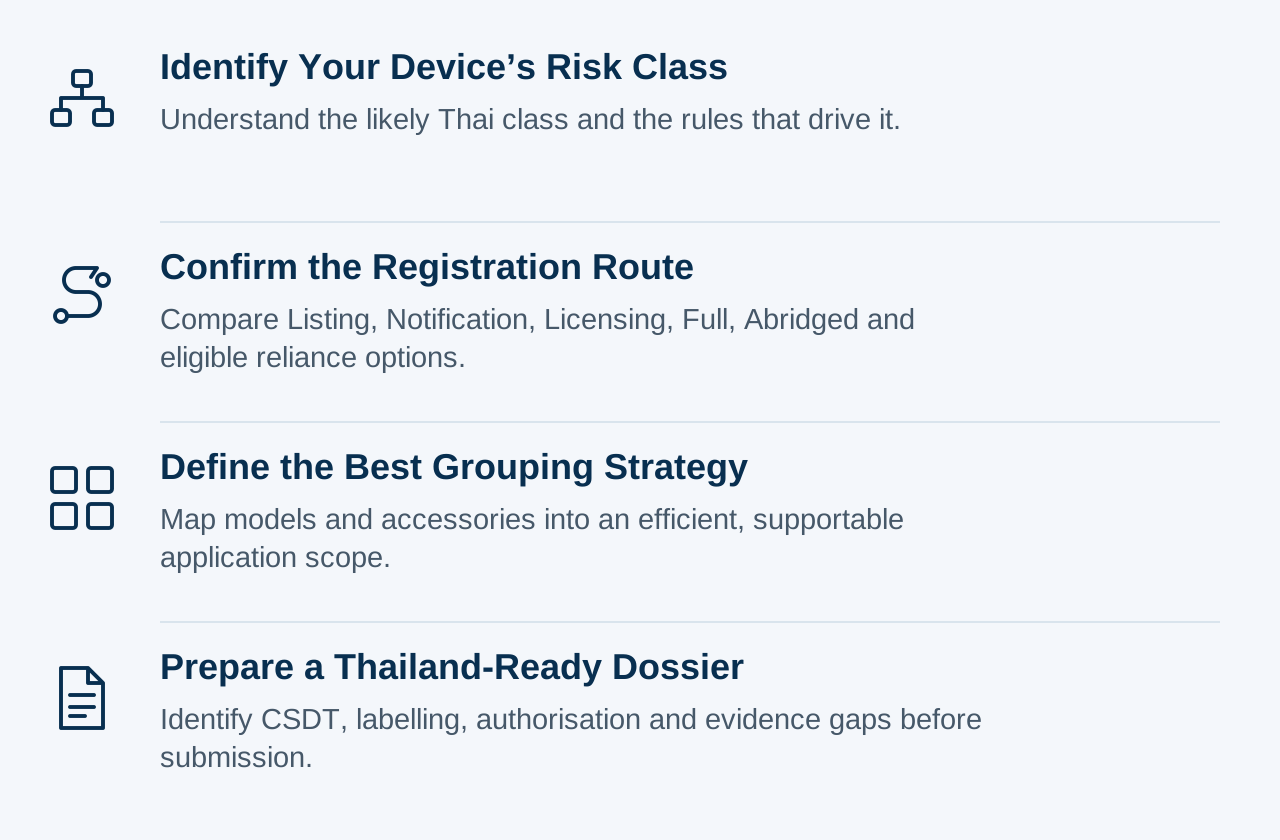
Understand the likely Thai class and the rules that drive it.
Compare Listing, Notification, Licensing, Full, Abridged and eligible reliance options.
Map models and accessories into an efficient, supportable application scope.
Identify CSDT, labelling, authorisation and evidence gaps before submission.
Need help with classification, grouping strategy, or registration pathway?
*Accepted file types include IFUs, Brochures, or existing Approval documents. Please attach to help us assess your product.
Initial assessment within 1 business day
| Thai FDA Fees | ||||
|---|---|---|---|---|
| Device Classification | Submission Fee | Approval Fee | External Expert Fee (If Required) | Turnaround Time |
| Class 1 Listing | THB 500 | THB 2,600 | - | Instant ~ 2 months |
| Class 2 Notification | THB 1,000 | THB 10,000 | THB 38,000 | 2 ~ 5 Months |
| Class 3 Notification | THB 1,000 | THB 10,000 | THB 38,000 | 2 ~ 5 Months |
| Class 4 Licensing | THB 1,000 | THB 20,000 | THB 53,000 | 4 to 6 Months |