
Vietnam Medical Device Registration & Regulatory Services

MediPass helps foreign manufacturers navigate Vietnam’s Ministry of Health requirements – from risk classification and filing scope to Class A/B declarations, Class C/D circulation registration, local registration-holder coordination, import readiness and post-market compliance.

Classification & Filing

A-D risk classification, Submission planning

Registration Pathways

Class A/B declarations; Class C/D fast-track or standard registration

Local Registrant ​

Authorization, Warranty and Importer coordination

Post-Market Obligations

Complaint Handling, Adverse Event Reporting, FSCA & Recall

ASEAN Expansion

Vietnam & Southeast Asia
Strategy

ASEAN EXPANSION STRATEGY

One Regional Partner
for Foreign Manufacturers

The ASEAN Medical Device Directive (AMDD) supports regulatory harmonisation across Southeast Asia, but it does not create a single approval valid across all ASEAN markets. In practice, each country still maintains its own regulatory authority, local requirements, and registration pathway.

For foreign manufacturers, MediPass supports Vietnam-specific market entry under Infrastructure and Medical Device Administration (IMDA) while serving as the One Regional Partner for broader ASEAN planning. We help align classification, registration scope, local representation, and post-market coordination across multiple ASEAN markets.

Vietnam Market Snapshot

Key demographic, economic, and medical device registration indicators relevant to Vietnam market entry.

Country Overview

Selected macro indicators based on 2025 data

Population

101.6 million

Median Age

33.4 years

GDP

US$ 514 billion

GDP per Capita

US$ 5,066

Medical Device

Selected MOH Medical Device indicators (last update on 19th Aug 2026)

Listed Devices

69,976

Risk-Class

A:25%, B:53%, C&D:22%

General Medical Devices(B,C,D)

82%

IVDs (B,C,D)

18%

Regulatory Overview​

Medical Devices in Vietnam

Regulated by the Ministry of Health (MOH), primarily through the Infrastructure and Medical Device Administration (IMDA), under Decree No. 98/2021/ND-CP, as amended. Devices are classified as Classes A–D. Classes A/B require a provincial declaration of applicable standards, while Classes C/D require MOH circulation registration through the electronic portal.

Registration Process

Determine

Device Status

Classify

A / B / C / D

Filing Plan

Grouping

Prepare

CSDT Dossier

Submit

MOH Portal

Registration Pathways

In Vietnam, Classes A and B use a declaration procedure, while Classes C and D require circulation registration. Reference-country approvals may support fast-track review for eligible C/D devices. Statutory review periods begin only after a complete and valid application, fee payment and any required dossier appraisal.

Class A & B

Class A and B medical devices follow a Declaration of Applicable Standards pathway with the competent Provincial Department of Health. Once the declaration is published on the official portal, the device may be marketed in Vietnam, subject to ongoing regulatory compliance.

Class C & D

Standard

The Standard Route applies to Class C and D devices that do not qualify for fast-track review. It requires CSDT appraisal by an MOH-designated unit before circulation registration. Certain IVD devices may require local quality testing, while medical-device disinfectants require composition and biological efficacy testing.

Fast-track

Eligible devices authorised by the US FDA; Australia’s TGA; Health Canada; Japan’s MHLW or PMDA; the United Kingdom; Switzerland; China’s NMPA; South Korea’s MFDS; or an EU Member States (MDR/IVDR). Devices with qualifying prior commercial authorisation in Vietnam, or approval from another authority recognised by Vietnam, may also qualify.

Grouping Strategy for Efficient Registration Planning

In Vietnam, medial devices may be classified as a Single Device, Family, System, Group, IVD Test Kit or IVD Cluster. Early grouping helps align the risk class, model scope, labels and technical dossier while avoiding duplicate / split applications.

Core Rules

· Permitted variants   · One Product Owner · One common intended purpose

Single

A medical device from one product owner, identified by a proprietary or brand name, with a specific intended purpose and supplied as a distinct packaged entity. A product should be registered as a Single Device when it does not meet the eligibility requirements for a Family, System, Group, IVD Test Kit or IVD Cluster.

Family

A collection of medical devices from the same product owner and of the same risk classification, sharing a common intended purpose, common design and manufacturing process, and only permissible variants (size, length, diameter, colour, flexibility, memory capacity, sterilization method and etc.)

System

Compatible medical devices and accessories intended to work together for one common medical purpose. Their labels, IFUs or catalogues must establish their use as a system. Third-party components may be included where the system owner assumes responsibility and provides supporting compatibility evidence.

Group

Two or more non-IVD devices supplied in one package under a single group name and common medical purpose. The quantity or combination may vary, but the package must identify its contents. Devices sold separately, including replacements, require their own registration.

IVD Test Kit

Compatible reagents or articles used together for one specific diagnostic purpose under a common test-kit name. An analyser is not included and should normally be handled as part of an IVD system. Replacement reagents may be supplied separately within the approved scope.

IVD Cluster

Available only for eligible Class A or B IVD reagents or articles from the same product owner. Products must share the same risk class, test methodology and recognized cluster category. Class C or D IVDs cannot use this grouping route.

Get Your Free Vietnam Market Assessment

Submit your product details and let MediPass recommend the most efficient filing strategy — saving you time, reducing costs, and providing actionable guidance for smooth market entry in Vietnam, and across Southeast Asia.
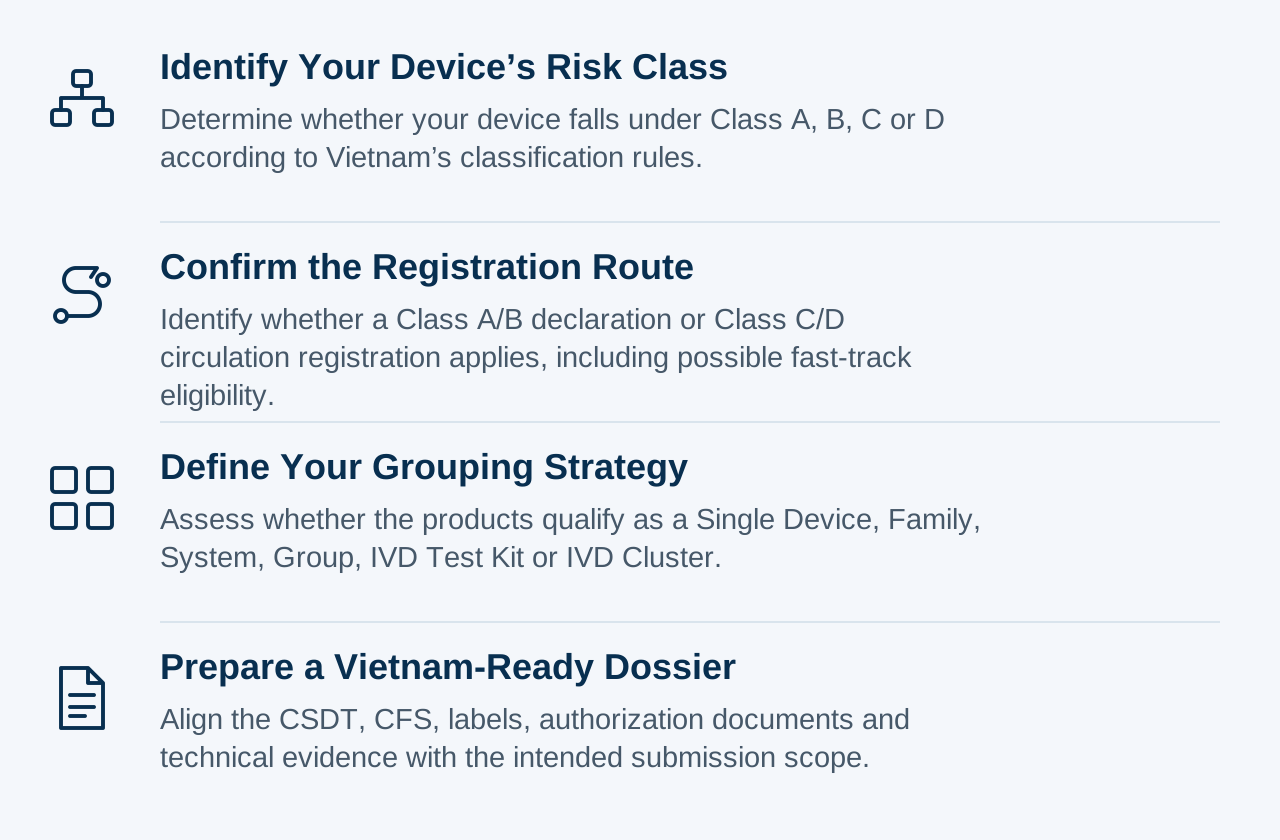
Vietnam assessment: device classification, registration route, grouping strategy and dossier preparation
Identify Your Device’s Risk Class

Determine whether your device falls under Class A, B, C or D according to Vietnam’s classification rules.

Confirm the Registration Route

Identify whether a Class A/B declaration or Class C/D circulation registration applies, including possible fast-track eligibility.

Define Your Grouping Strategy

Assess whether the products qualify as a Single Device, Family, System, Group, IVD Test Kit or IVD Cluster.

Prepare a Vietnam-Ready Dossier

Align the CSDT, CFS, labels, authorization documents and technical evidence with the intended submission scope.

Need help with classification, grouping strategy, or registration pathway?

*Accepted file types include IFUs, Brochures, or existing Approval documents. Please attach to help us assess your product.

Initial assessment within 1 business day

Vietnam IMDA Fee Overview
Device Classification Application Fees (Until 31 Dec 2026) Turnaround time (TAT)
Standard Fast-track
Class A VND 500,000 10 Days
Class B VND 1,500,000
Class C / D VND 3,000,000 6 to 10 Months 2 to 4 Months
Scroll to Top